Accounting Services Across Switzerland
Miss one Swiss filing deadline and the penalties — plus your bank’s questions — land on you. We take bookkeeping, VAT, payroll, tax and your statutory audit off your desk entirely, in English, for one fixed monthly fee agreed before we start. Run by a fiduciary with 20+ years’ experience and a Big Four background, for companies in any of the 26 cantons.
Why Choose Us
A Swiss Fiduciary Firm Built for International Clients
Most foreign founders find out too late that a cheap online bookkeeping tool cannot sign a Swiss statutory audit or answer a cantonal tax office. Swiss Treuhand Partners is a licensed fiduciary firm — a Treuhand — whose certified professionals work daily with the Swiss Code of Obligations (OR), all 26 cantonal tax systems, and Switzerland’s three-level tax framework.
Whether your company is incorporated in low-tax Zug, financial hub Zürich, international Geneva, or pharma capital Basel, we provide consistent, English-language accounting services tailored to your canton’s regulations, tax rates, and filing deadlines. Our team operates across German-speaking and French-speaking Switzerland, so your fiduciary firm scales with you if your business expands to additional cantons.
Our practice is led by a senior fiduciary professional with over 20 years of experience and a Big Four background, registered with the Swiss Federal Audit Oversight Authority (RAB). This means your statutory audit reports are legally valid and your financial statements meet the standards that Swiss banks, investors, and authorities expect.
English-Speaking Team
No translation errors on tax filings, commercial register documents, or authority correspondence
All 26 Cantons
Local knowledge of cantonal tax rates, authority contacts, and filing deadlines across Switzerland
RAB-Registered Auditor
One firm for bookkeeping, tax returns, and legally valid statutory audits
Fixed Monthly Pricing
Predictable costs with no surprise invoices — all fees agreed upfront
Swiss GAAP & IFRS
Financial statements prepared under Swiss GAAP FER or IFRS as required
Bank-Grade Compliance
Financial reporting accepted by Swiss banks, FINMA, and institutional investors
Understanding Swiss Accounting
Accounting Obligations for Companies in Switzerland
Every company incorporated in Switzerland — whether a GmbH, AG, branch office, or subsidiary of a foreign corporation — is subject to accounting and reporting obligations defined in the Swiss Code of Obligations (Art. 957–963b CO). These requirements apply regardless of company size and cannot be delegated away: the board of directors (Verwaltungsrat) bears ultimate responsibility for proper financial reporting.
At a minimum, Swiss companies must maintain double-entry bookkeeping in Swiss francs (CHF), prepare annual financial statements consisting of a balance sheet (Bilanz), income statement (Erfolgsrechnung), and notes to the financial statements (Anhang). Larger companies — those exceeding CHF 20 million in revenue — must also prepare a cash flow statement and a management report (Lagebericht).
The Swiss Three-Level Tax System
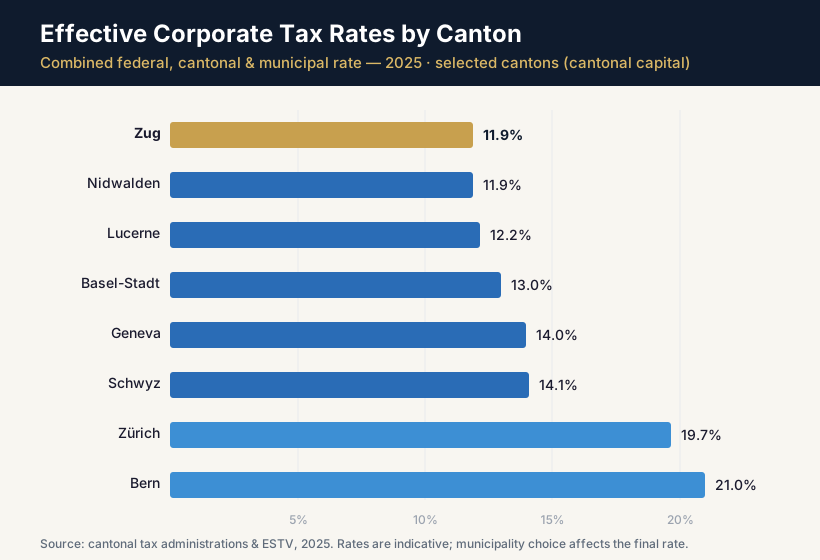
Switzerland’s corporate tax structure is unique in that it operates on three independent levels: federal, cantonal, and municipal. The federal corporate income tax rate is a flat 8.5% on net profit, applied uniformly across the country. Cantonal and municipal rates, however, vary significantly — creating effective combined rates that range from approximately 11.9% in the most competitive jurisdictions (Zug, Nidwalden) to around 21% in others (Bern, Solothurn).
This structure creates real planning opportunities. The choice of canton and municipality for your registered office can reduce your annual tax burden by tens of thousands of francs. Beyond location, STAF-era instruments (Swiss Federal Tax Reform and AHV Financing, effective 2020) including patent box deductions, R&D super-deductions of up to 150%, and step-up provisions for companies relocating to Switzerland, provide further avenues for legitimate tax reduction.
Why International Businesses Choose Switzerland
Switzerland consistently ranks among the world’s most attractive jurisdictions for corporate establishment. Beyond competitive tax rates, businesses benefit from political and economic stability anchored by the Swiss franc, a central European location with excellent transport links, access to a highly educated multilingual workforce, and a legal system built on predictability and the rule of law.
With over 100 double taxation agreements covering virtually all major economies, Switzerland offers efficient cross-border structures for holding companies, trading firms, IP management entities, and international group headquarters. The participation exemption (Beteiligungsabzug) can effectively eliminate tax on qualifying dividend income from subsidiaries, while DTAs reduce withholding tax on outbound dividends to as low as 0–5% in many treaty relationships.
Payroll and Social Insurance in Switzerland
Swiss payroll is complex by international standards. Employers must manage mandatory contributions to AHV/IV/EO (first pillar — old age, disability, and loss of earnings insurance at 10.6% total), ALV (unemployment insurance at 2.2% on salary up to CHF 148,200), BVG (second pillar occupational pension, varying by age and provider), UVG (accident insurance — both occupational and non-occupational), and FAK (family allowance fund, varying by canton). For foreign employees without a C permit, the employer must also calculate and withhold Quellensteuer (withholding tax at source), which varies by canton, marital status, and number of dependents.
Each employee must receive an annual Lohnausweis (salary certificate) — a standardized form that reports total compensation, benefits, and deductions for the employee’s personal tax return. Errors on the Lohnausweis are common and can trigger tax authority inquiries for both the company and the employee.
VAT in Switzerland
Swiss VAT (Mehrwertsteuer / MWST / TVA) is administered by the Federal Tax Administration (ESTV). Registration is mandatory once worldwide turnover exceeds CHF 100,000 per year. The standard rate is 8.1%, with a reduced rate of 2.6% for everyday goods (food, non-alcoholic beverages, medicines, books, newspapers) and a special rate of 3.8% for accommodation services.
Companies can file under the effective method (actual input tax deduction) or the flat-rate method (Saldosteuersatz), which applies a sector-specific rate to gross revenue and simplifies quarterly filing. The flat-rate method is attractive for service-based businesses with limited input VAT, while companies with significant capital expenditure or inventory purchases generally benefit from the effective method. VAT returns are filed quarterly, and voluntary registration below the CHF 100,000 threshold is permitted — often advisable for startups expecting significant input VAT on initial investments.
Our Services
Full-Spectrum Accounting & Fiduciary Services
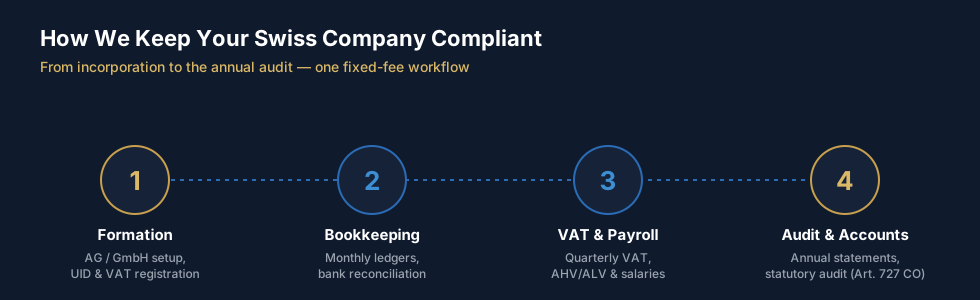
From company formation to annual audit — everything your Swiss business needs under one roof, delivered in English with fixed pricing.
Bookkeeping & Financial Accounting
Monthly or quarterly bookkeeping, accounts payable and receivable, bank reconciliation, and annual financial statements prepared under Swiss GAAP FER or the minimum requirements of Art. 957a CO. We support Abacus AbaWeb, Bexio, and can migrate from other systems. Includes balance sheet, income statement, and notes — ready for tax filing and, where required, audit.
Corporate Tax Advisory & Returns
Federal and cantonal/municipal corporate tax returns, including profit tax and capital tax calculations. Tax optimisation through holding privilege structures, patent box deductions (STAF), R&D super-deductions, and intercompany transfer pricing. Double taxation agreement analysis for cross-border structures. Pre-incorporation tax modelling to select the optimal canton and municipality.
Audit & Statutory Review
Ordinary audits (Ordentliche Revision) for companies exceeding Art. 727 CO thresholds, limited statutory examinations (Eingeschränkte Revision) for smaller companies, and opt-out documentation for micro-entities with fewer than 10 FTEs. Conducted by our RAB-registered auditor under Swiss Auditing Standards (SAS). Swiss GAAP FER and IFRS engagements.
Payroll & Salary Administration
Full payroll cycle management: AHV/IV/EO contributions, ALV unemployment insurance, BVG pension fund coordination, UVG accident insurance (BU + NBU), FAK family allowances. Quellensteuer (withholding tax) calculation for foreign employees (B permit, cross-border commuters). Monthly pay slips and annual Lohnausweis salary certificates for every employee.
VAT Registration & Compliance
VAT registration with ESTV (Federal Tax Administration), selection and implementation of the effective or flat-rate (Saldosteuersatz) method, quarterly return preparation and filing, input tax deduction optimisation. Cross-border VAT advice for imports, exports, and reverse-charge scenarios. Voluntary registration below CHF 100,000 threshold where beneficial.
Company Formation Support
Full support for GmbH (min. CHF 20,000 share capital) and AG (min. CHF 100,000 share capital) formation in any Swiss canton — notary coordination, articles of association drafting, Handelsregister filing, opening a Swiss corporate bank account, VAT registration, social insurance registration, and accounting system setup. Nominee director services available for non-resident founders.
Cantonal Tax Comparison
Corporate Tax Rates Across Swiss Cantons
Switzerland’s three-level tax system — federal, cantonal, municipal — means your choice of canton and municipality significantly impacts your effective tax rate. We help you model the optimal structure before you incorporate.
| Canton / City | Effective Rate | Key Advantages |
|---|---|---|
| Zug (city) | ~11.9% | Lowest combined rate, crypto-friendly ecosystem, central location |
| Nidwalden (Stans) | ~11.9% | Competitive rate, favourable holding structures, proximity to Lucerne |
| Lucerne (city) | ~12.2% | Strong business infrastructure, university city, central Switzerland hub |
| Uri (Altdorf) | ~12.6% | Low rate, Gotthard corridor, efficient administration |
| Obwalden (Sarnen) | ~12.7% | Attractive rate, simplified administration, low cost of living |
| Appenzell I.Rh. | ~12.7% | Very low rate, traditional business-friendly environment |
| Basel-Stadt | ~13.0% | Pharma/biotech hub (Roche, Novartis), border location (DE/FR) |
| Schaffhausen | ~13.4% | Northern Switzerland, competitive rate, German border access |
| Geneva | ~14.0% | International hub, French-speaking, commodity trading, UN/WHO presence |
| Schwyz (Freienbach) | ~14.1% | Near Zürich, favourable capital gains, Lake Zürich access |
| Zürich (city) | ~19.7% | Financial centre, largest talent pool, global connectivity, ETH/UZH |
| Bern (city) | ~21.0% | Capital city, government contracts, bilingual (DE/FR) |
Federal corporate tax is 8.5% on net profit across all cantons. Rates shown are approximate effective combined rates (federal + cantonal + municipal) as of 2025. Actual rates depend on specific municipality, applicable deductions (patent box, R&D, STAF provisions), and company structure. Contact us for a personalized tax comparison.
Credentials & Standards
Built on Real Swiss Expertise
We would rather show you our credentials than publish anonymous quotes. Here is what stands behind every engagement.
20+ Years & Big Four Background
Led by a senior fiduciary professional with over two decades of practice and a Big Four audit pedigree.
RAB-Registered Auditor
Statutory audits signed off by an auditor registered with the Swiss Federal Audit Oversight Authority (RAB) — legally valid reports.
Swiss GAAP FER & IFRS
Financial statements prepared to the standards Swiss banks, investors, and authorities require.
All 26 Cantons
Filings aligned with ESTV and cantonal authorities, with fixed monthly pricing agreed upfront.
Get Started
Free 30-Minute Consultation
In 30 minutes you will know exactly what your Swiss company must file, what it will cost — fixed, in writing — and whether we are the right fit. No obligation and no sales script. Tell us about your company below and we reply within one business day.
Or call us directly: +41 44 515 25 53
FAQ
Frequently Asked Questions
Answers to the most common questions about accounting, tax, audit, and company formation in Switzerland.